Field Guides / AI Agents for DevOps
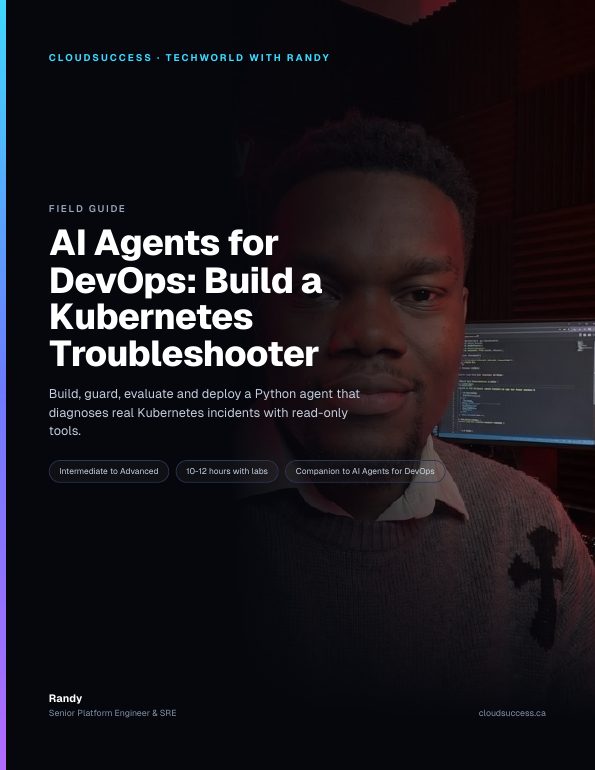
Field Guide · Intermediate to Advanced · 10-12 hours with labsAI Agents for DevOps: Build a Kubernetes Troubleshooter
Build a Python agent that diagnoses real Kubernetes incidents with read-only tools, guardrails, evals and least-privilege RBAC.
87
pages
pages
12
hands-on labs
hands-on labs
25
interview Q&As
interview Q&As
13
chapters
chapters
This is for you if
- You run Kubernetes and want to know what an ops agent really is in code
- You write some Python and know kubectl, Deployments, Services and RBAC
- You are interviewing for SRE, platform or AI-engineering roles
- You will be asked to review or approve someone else's agent
What's inside
- A complete ~500-line agent: tool-calling loop on the OpenAI-compatible API
- Four read-only kubectl tools with allowlists, validation, redaction and truncation
- Running the same agent on Ollama locally and on a hosted API
- Structured outputs: a Pydantic diagnosis with self-correcting validation
- Prompt injection defences, hard vs soft guardrails, and an injection test case
- Six seeded incidents and an eval harness with pass rate, p95 latency and tokens
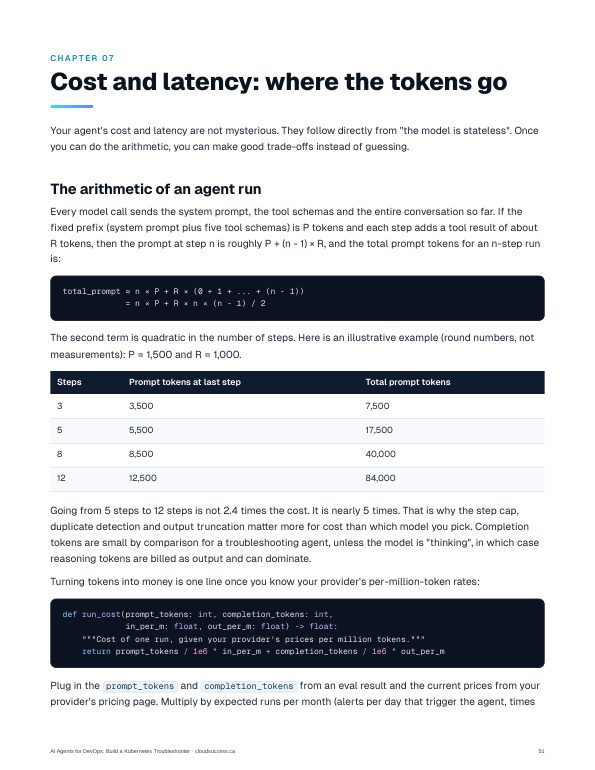
- Token and latency arithmetic, plus the levers that actually cut cost
- In-cluster Job with a get/list-only ClusterRole and per-namespace RoleBindings
- Human-approved write actions with server-side dry runs and an audit log
After this guide you can
- Explain and build an LLM tool-calling loop without a framework
- Design agent tools and RBAC that stay safe when the model is fooled
- Evaluate an agent on seeded incidents and compare models with real numbers
- Estimate and reduce the cost and latency of agent runs
- Deploy the agent in-cluster with least privilege and a human approval step
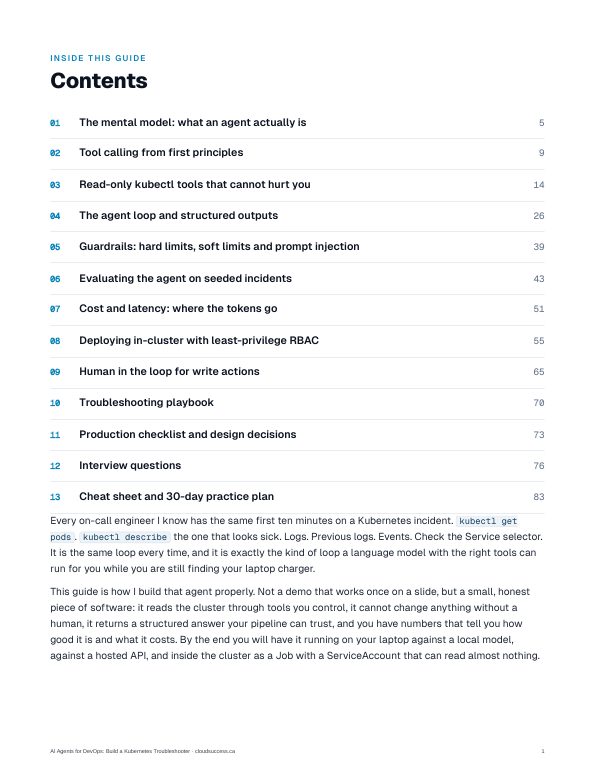
Contents
- The mental model: what an agent actually isp. 5
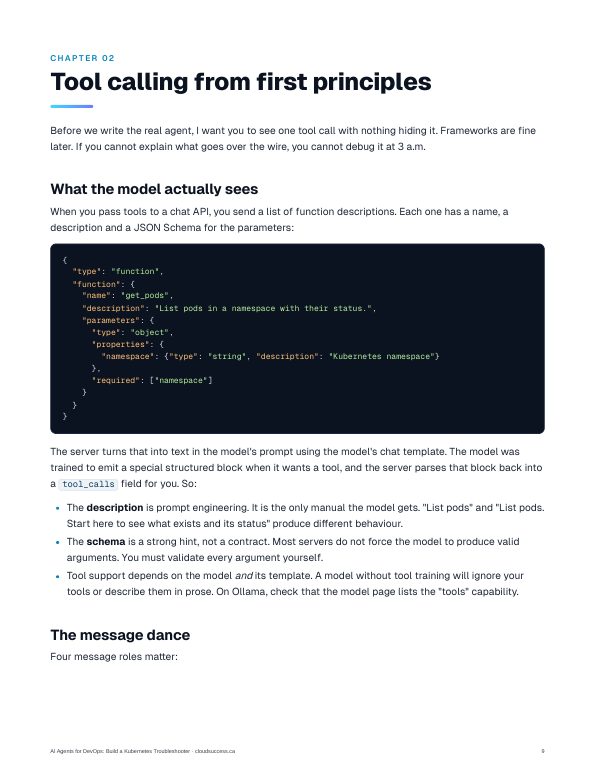
- Tool calling from first principlesp. 9
- Read-only kubectl tools that cannot hurt youp. 14
- The agent loop and structured outputsp. 26
- Guardrails: hard limits, soft limits and prompt injectionp. 39
- Evaluating the agent on seeded incidentsp. 43
- Cost and latency: where the tokens gop. 51
- Deploying in-cluster with least-privilege RBACp. 55
- Human in the loop for write actionsp. 65
- Troubleshooting playbookp. 70
- Production checklist and design decisionsp. 73
- Interview questionsp. 76
- Cheat sheet and 30-day practice planp. 83
Written by Randy, a Senior Platform Engineer & SRE who runs production platforms on AWS, GCP and Azure. Companion to the Techworld with Randy episode AI Agents for DevOps.