Field Guides / AI Platform Engineering
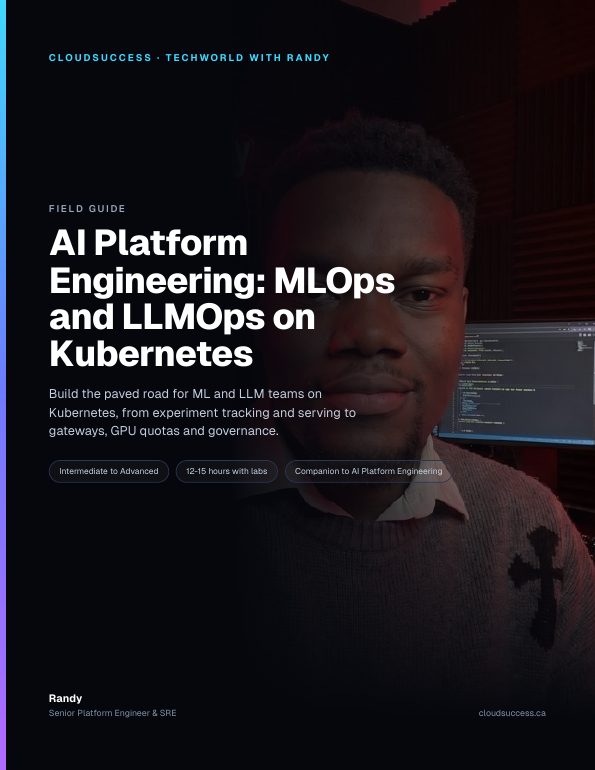
Field Guide · Intermediate to Advanced · 12-15 hours with labsAI Platform Engineering: MLOps and LLMOps on Kubernetes
Build the paved road for ML and LLM teams on Kubernetes: registry, serving, LLM gateway, eval gates, GPU queues and governance.
99
pages
pages
12
hands-on labs
hands-on labs
24
interview Q&As
interview Q&As
13
chapters
chapters
This is for you if
- You're a platform engineer or SRE who has been asked to support data science and LLM teams
- You want to move into AI platform, ML platform or MLOps roles and need hands-on proof
- Your teams have scattered model API keys, no idea of LLM spend and fights over GPUs
- You need to answer 'which model is in production and who approved it?' with evidence
What's inside
- What an AI platform team owns, how the role differs from ML and AI engineers, and the ML lifecycle in platform terms
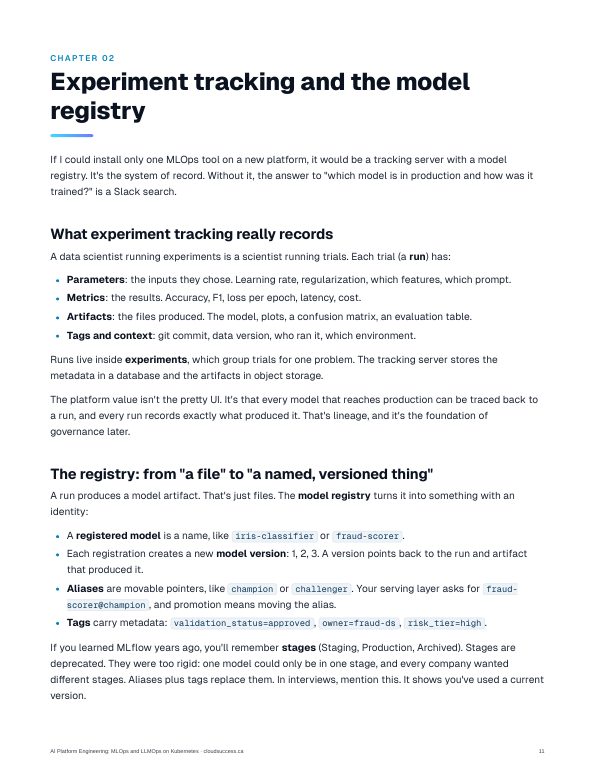
- MLflow 3 on Kubernetes: tracking, model registry with aliases, the Host-header security setting that trips upgrades, and lineage
- Data, features and training: feature stores and training/serving skew, Kubeflow Trainer, KubeRay and in-cluster training Jobs
- KServe v0.21 in Standard mode: InferenceService internals, runtimes, protocols, autoscaling and a registry-to-serving hand-off
- An LLM gateway with LiteLLM and Ollama: model aliases, fallbacks, per-team keys, rate limits, budgets and cost per request
- Evaluation pipelines and a prompt registry, with a working eval gate that decides whether a prompt version gets promoted
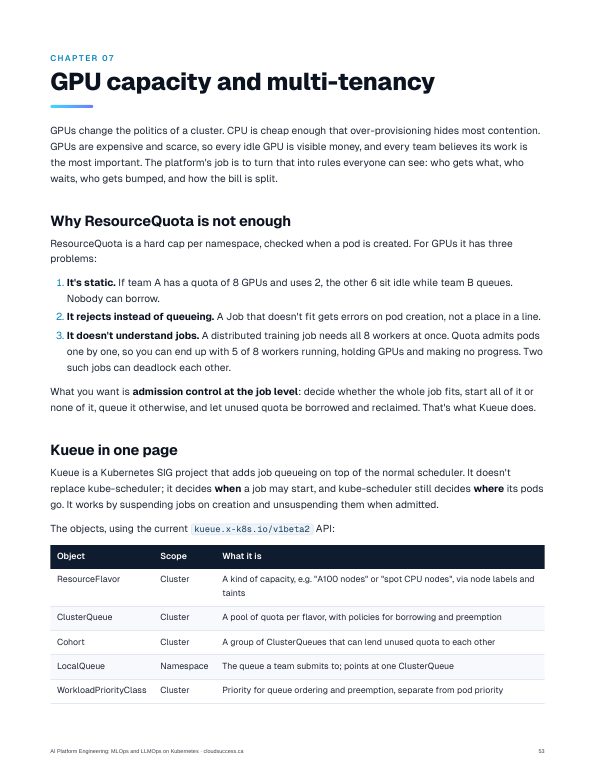
- GPU capacity with Kueue v1beta2: cohorts, borrowing, reclaim and priority preemption, plus chargeback and showback
- Model observability and governance: PSI drift checks, model cards, approvals and a ValidatingAdmissionPolicy for serving
- A golden-path Helm chart, a reference architecture, troubleshooting playbook, 24 interview Q&As, cheat sheets and a 30-day plan
After this guide you can
- Run MLflow on Kubernetes and promote models with aliases and approval tags instead of copying files
- Serve registered models with KServe and explain why the serving runtime is part of the model contract
- Put every LLM call behind a gateway with team keys, limits, budgets and visible cost
- Gate model and prompt changes with recorded evaluations
- Share scarce capacity fairly with Kueue queues, cohorts and preemption
- Design and defend a multi-team AI platform architecture in a design review or interview
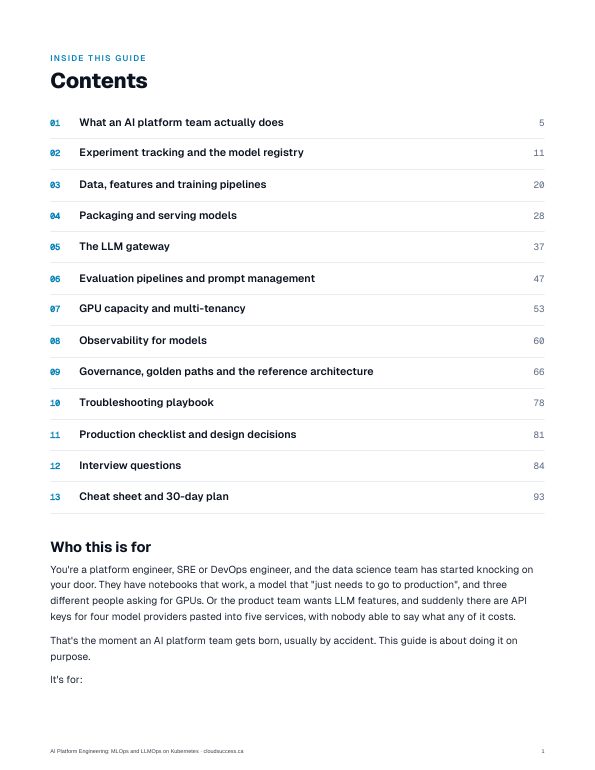
Contents
- What an AI platform team actually doesp. 5
- Experiment tracking and the model registryp. 11
- Data, features and training pipelinesp. 20
- Packaging and serving modelsp. 28
- The LLM gatewayp. 37
- Evaluation pipelines and prompt managementp. 47
- GPU capacity and multi-tenancyp. 53
- Observability for modelsp. 60
- Governance, golden paths and the reference architecturep. 66
- Troubleshooting playbookp. 78
- Production checklist and design decisionsp. 81
- Interview questionsp. 84
- Cheat sheet and 30-day planp. 93
Written by Randy, a Senior Platform Engineer & SRE who runs production platforms on AWS, GCP and Azure. Companion to the Techworld with Randy episode AI Platform Engineering.