How to Properly Apply for Jobs With AI
A real workflow for using AI to tailor applications, prep for interviews, and track your search — plus the mistakes that get AI-generated applications filtered out instantly.
What you get
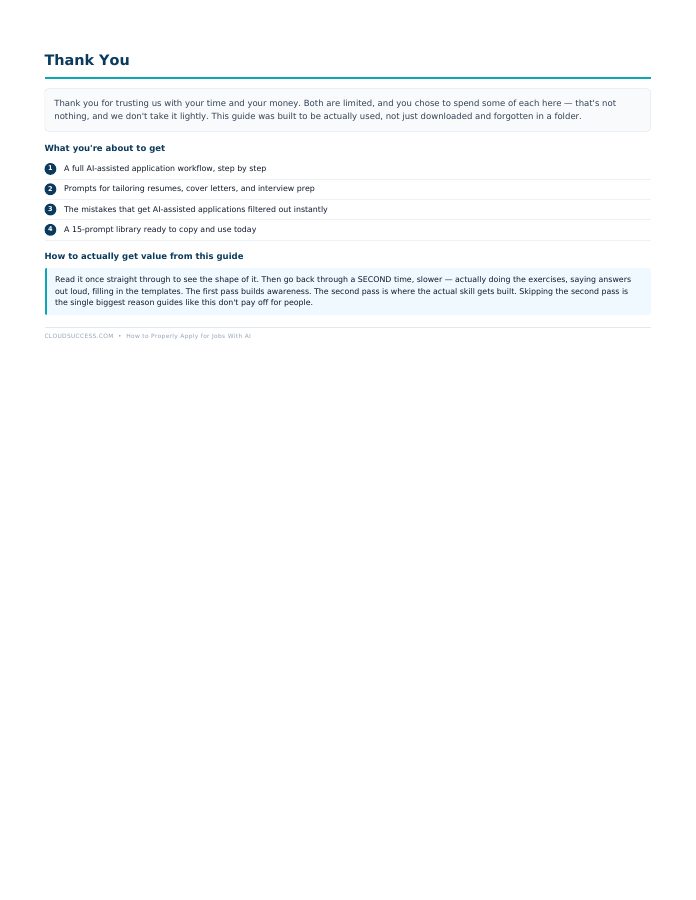
- A full AI-assisted application workflow, step by step
- Prompts for tailoring resumes, cover letters, and interview prep
- Prompts for your LinkedIn headline and About section
- The mistakes that get AI-assisted applications filtered out instantly
- AI interview red flags employers are now screening for
- A 15-prompt library ready to copy and use today
What's inside
- The Right Way to Think About AI in a Job Search
- The Full AI-Assisted Application Workflow
- Tailoring Your Resume Per Job Description — With Prompts
- Writing Cover Letters That Don't Read as AI-Generated
- Using AI to Research a Company Before Applying
- Using AI to Prep for Interviews — With Prompts
- Optimizing Your LinkedIn Profile With AI — With Prompts
- Tracking Your Search With AI
- The Mistakes That Get AI-Assisted Applications Filtered Out
- A Full Prompt Library (15 Ready-to-Use Prompts)
- AI Interview Red Flags Employers Are Now Screening For
A look inside: Writing Cover Letters That Don't Read as AI-Generated
Hiring managers read a LOT of cover letters now, and generic AI phrasing ("I am excited about the opportunity to leverage my skills...") is increasingly easy to spot and increasingly penalized.
PROMPT (FIRST DRAFT): "Draft a cover letter for this role: [paste JD]. Use these 3 specific points about my background: [point 1], [point 2], [point 3]. Keep it under 250 words, avoid generic enthusiasm phrases, and write it as if I am explaining directly to the hiring manager why this specific role makes sense for me right now."
The real test: read the final version out loud. If it doesn't sound like something you would actually say in conversation, rewrite the sentence until it does.
How to Properly Apply for Jobs With AI: Mastery Edition
The full workflow, all 25 prompts, the AI red-flag list, a real timed demo, and the verification checklist that keeps AI-assisted applications honest instead of risky.