The System Design Interview Framework
One repeatable 6-step framework, 3 fully worked examples with polished diagrams, a complete pattern catalog, and the vocabulary that signals fluency under pressure.
What you get
- The 6-step framework that works for any prompt
- 3 fully worked designs with real architecture diagrams
- Caching, DB scaling, queues, and load balancing patterns
- Vocabulary cheat sheet — the exact terms that matter
- How grading actually works — the hidden rubric
- Common mistakes that quietly cost points
What's inside
- The Framework: 6 Steps, Every Time
- Worked Example 1: URL Shortener
- Worked Example 2: On-Call Alerting System
- Worked Example 3: CI/CD for 50+ Microservices
- The Complete Pattern Catalog: Caching, Database Scaling, Queues & Load Balancing
- Vocabulary Cheat Sheet
- Common Mistakes That Cost Points
- How Grading Actually Works
- Practice Template (Fill From Memory Before Every Interview)
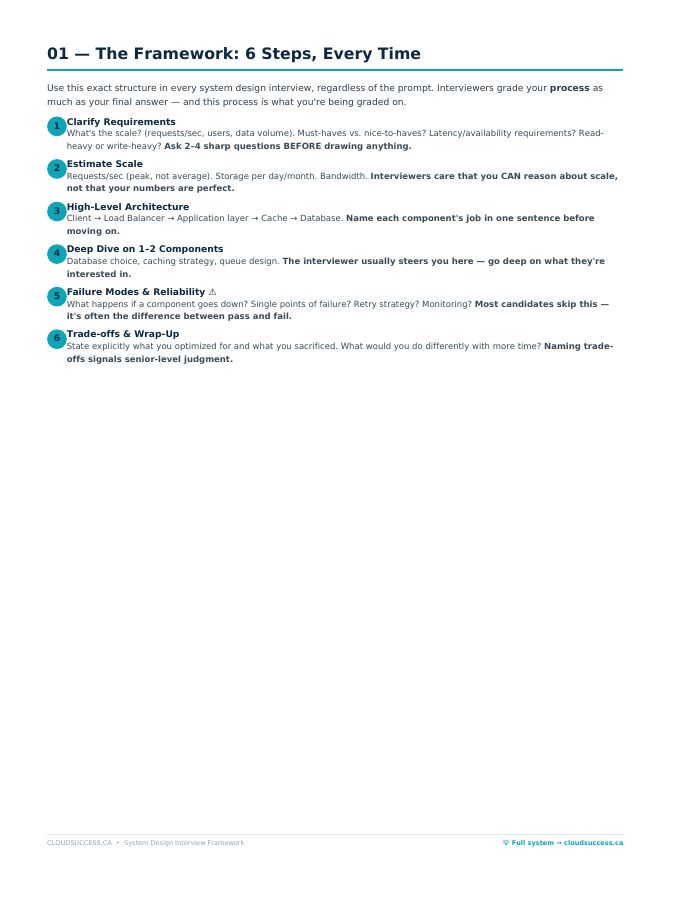
A look inside: The Framework: 6 Steps, Every Time
Use this exact structure in every system design interview, regardless of the prompt. Interviewers grade your process as much as your final answer — and this process is what you're being graded on.
1. Clarify Requirements — What's the scale? (requests/sec, users, data volume). Must-haves vs. nice-to-haves? Latency/availability requirements? Read-heavy or write-heavy? Ask 2–4 sharp questions BEFORE drawing anything.
5. Failure Modes & Reliability — What happens if a component goes down? Single points of failure? Retry strategy? Monitoring? Most candidates skip this — it's often the difference between pass and fail.
6. Trade-offs & Wrap-Up — State explicitly what you optimized for and what you sacrificed. What would you do differently with more time? Naming trade-offs signals senior-level judgment.
The System Design Interview Framework: Mastery Edition
The full 6-step framework, 6 worked designs each with its own architecture diagram, the complete pattern catalog, and a full scored mock interview — rebuilt so every design is something you can actually see, not just read about.